Understanding Customer Data Platforms (CDPs): The Key to Enhanced Customer Experience
In today’s data-driven world, understanding and leveraging customer data is crucial for businesses aiming to provide exceptional customer experiences. This is where Customer Data Platforms (CDPs) come into play. But what exactly is a CDP, and how does it work? In this blog post, we will break down the concept of a CDP, its functionalities, and its importance in enhancing Customer Experience (CX).
What is a Customer Data Platform (CDP)?
A Customer Data Platform (CDP) is a centralized system that collects, unifies, analyzes, and activates customer data from various sources. It enables businesses to create a comprehensive view of their customers, facilitating personalized marketing and improved customer engagement.
Let’s dive into the four primary functions of a CDP: Connect, Unify, Analyze, and Activate.
1. Connect
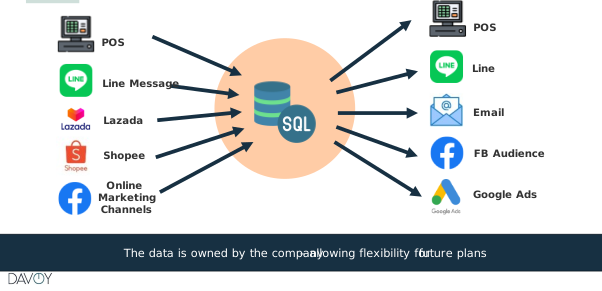
The first step in leveraging a CDP is connecting various data sources. A CDP gathers data from multiple touchpoints, ensuring no customer interaction goes unnoticed. Here are some key data sources:
- Customer Data: Collect data from various customer interactions to build detailed customer profiles.
- POS (Point of Sale): Integrate data from physical store transactions, capturing purchase behavior and preferences.
- Online Sales: Gather data from online sales transactions, including e-commerce platforms and marketplaces.
- Online Behavior: Monitor online behavior such as browsing patterns and social media activities (e.g., Facebook).
- Comments: Collect feedback and comments from customers across different platforms.
- Contact Us: Use data from customer inquiries and contact forms to understand customer needs and concerns.
2. Unify
Once the data is collected, the next step is unifying it to create a single, cohesive view of each customer. This involves:
- Data Governance: Implementing policies for data management and compliance to ensure data accuracy and security.
- Data Collaboration: Enabling sharing and collaboration of data across different platforms and teams, breaking down data silos.
3. Analyze
With unified data, businesses can perform in-depth analyses to gain valuable insights into customer behavior and preferences. Key analytical functions include:
- Churn Analysis: Identify patterns and factors contributing to customer churn, enabling proactive retention strategies.
- Customer Segmentation: Segment customers based on various criteria such as demographics, behavior, and purchase history.
- Upsell Opportunities: Identify opportunities to upsell products or services to existing customers.
- Cross-sell Opportunities: Recognize potential for cross-selling complementary products.
- Customer Lifetime Value (CLV): Calculate and analyze the lifetime value of customers to prioritize high-value segments.
- Propensity to Buy: Assess the likelihood of customers making a purchase, enabling targeted marketing efforts.
- Net Promoter Score (NPS): Measure customer satisfaction and loyalty through NPS surveys.
- Loyalty Analysis: Analyze customer loyalty metrics to develop strategies for enhancing customer loyalty.
4. Activate
The final step is activating the insights gained from data analysis to drive personalized marketing and improved customer engagement. Activation strategies include:
- Email Marketing: Use data to personalize and send targeted email campaigns, increasing engagement and conversions.
- Offline Shop Strategies: Implement data-driven strategies in offline stores to enhance customer experience.
- SMS Marketing: Send personalized SMS messages to customers, offering promotions and updates.
- Facebook Advertising: Run targeted advertising campaigns on Facebook based on customer data.
- Line Messaging: Utilize Line messaging for customer engagement and communication.
Focus: Customer Experience (CX)
The overarching goal of a CDP is to enhance and optimize the customer experience. By leveraging customer data effectively, businesses can deliver personalized experiences, foster customer loyalty, and drive growth.
Examples of Popular CDPs
To give you a better understanding, here are some popular CDPs and their websites:
- Salesforce CDP: Salesforce CDP
- Adobe CDP: Adobe Real-Time CDP
- Treasure Data: Treasure Data CDP
- Meiro: Meiro CDP
Conclusion
In summary, a Customer Data Platform (CDP) is a powerful tool that enables businesses to connect, unify, analyze, and activate customer data. By doing so, businesses can gain valuable insights into customer behavior, tailor their marketing efforts, and ultimately enhance the customer experience. In today’s competitive landscape, investing in a CDP is not just an option but a necessity for businesses aiming to stay ahead.
By understanding and implementing a CDP, businesses can unlock the full potential of their customer data, driving better engagement, satisfaction, and loyalty.
If you are interested in using a CDP, you can consult with our team at @davoy.